
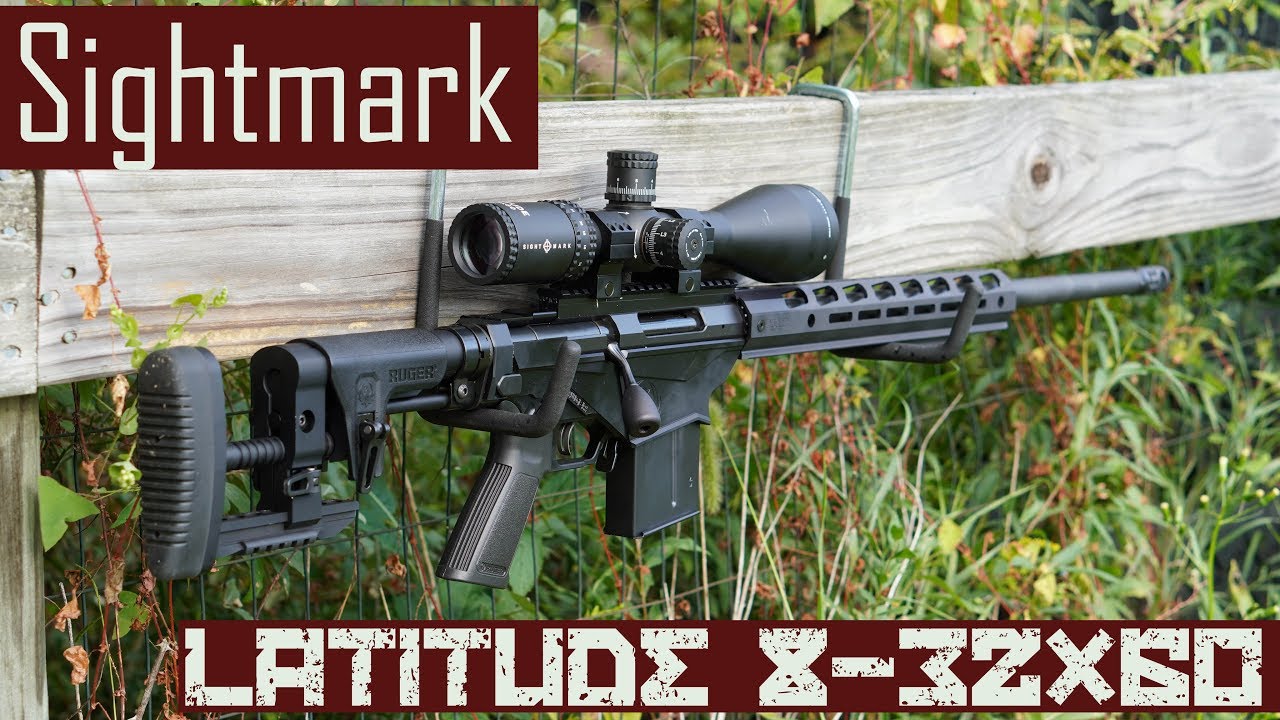
Channel fans and family, welcome to Slav Guns. The benchmark scope for my Precision Rifle Series has been the Leupold Mark 5HD 5-25×56. It’s a superb optic, but at around $2,500 it’s simply too much scope at too high a price for most people to justify. So for this episode I went looking for a mid-priced optic that fits most budgets and gets you about 90% of the high-end experience. That’s the Sightmark Latitude 8-32×60 F-Class riflescope, and I ran it on my Ruger Precision Rifle in 6.5 PRC.
Disclosure: Sightmark provided the scope for testing and evaluation. No compensation was received, and Sightmark did not see the video before it was published.
Heads-up: I filmed this in fall 2019. The price below is what it was at filming, and pricing and availability have likely changed since.
TL;DR
- 8-32×60, second focal plane, illuminated F-Class reticle with a tiny 0.06 MOA center dot.
- 34mm aircraft-grade aluminum tube, 110 MOA of elevation and 70 MOA of windage per Sightmark.
- Oversized turrets with 1/8 MOA clicks and a zero stop on elevation.
- Parallax from 20 yards to infinity, locking fast-focus eyepiece, IP67 rated, lifetime warranty.
- Just under $800 at filming. Turrets and parallax feel great; glass is good but gets dimmer in low light.
Is Sightmark worth a look?
I completely recognize that Sightmark isn’t a household name like Leupold, Nightforce, Bushnell, or even Nikon. This is actually the fourth Sightmark optic I’ve looked at on this channel. In my experience they make both very good optics at very reasonable prices and value optics where you really ought to spend more money and get something better. So which one is this?
In Sightmark’s lineup the Latitude series sits in the middle on price and features. At the low end you have the Citadel line. I reviewed the Citadel 5-30×56, and while the glass was pretty good, I was on the fence about the value and some of the features. Then you have the Core line, which is great for the AR platform. Above the Latitude sits the aptly named Pinnacle series.
The Latitude lineup
The Latitude series has five scopes made for precision shooting:
- 8-32×60 F-Class, the one I’m reviewing
- Two 10-40×60 models that differ in reticle choice
- Two 6.25-25×56 models, one of which is the PRS scope
Every one of them uses a second focal plane etched reticle except the 6.25-25×56 PRS, which is first focal plane. Quick refresher: with a first focal plane reticle, the reticle size changes as you change magnification. With a second focal plane reticle, it stays the same size across the whole magnification range.
Features
Tube and adjustment
All of these scopes use a 34mm tube made of aircraft-grade aluminum. The bigger tube increases the internal adjustment range. Per Sightmark you get 110 MOA of elevation and 70 MOA of windage. On the PRS model with its mil reticle, that works out to 31 mils of elevation and 20 mils of windage.
Turrets
One of the central features here is the nice oversized adjustment turrets. The 8-32 and the 10-40 scopes use 1/8 MOA clicks. On the 6.25-25 models, one has 1/4 MOA clicks and the PRS uses 0.1 mil clicks. You also get a zero stop on the elevation dial, which is almost a must for long range.
Eyepiece, controls, and reticle
- Locking fast-focus eyepiece. Set the diopter so you can clearly see the reticle, even if you have eye issues or wear glasses, then lock it in. It’s like a zero stop for your diopter setting.
- Texturing on the parallax knob, the magnification ring, and the turrets, so you can adjust them quickly even with gloves on.
- Illuminated reticle in red or green, powered by a single CR2032. Battery life runs anywhere from 30 to 2,000 hours depending on brightness.
- F-Class reticle with a 0.06 MOA center dot, which covers about 0.6 inches at 1,000 yards at max magnification.
- Parallax adjusts from 20 yards out to infinity.
- Field of view runs from 16.1 feet down to 4 feet depending on magnification.
- Fully multi-coated glass.
Durability and what’s in the box
The scope has a hard anodized finish and is IP67 rated: shockproof, fogproof, and waterproof. Sightmark rates it to handle the recoil of a .50 BMG. It’s designed in the United States and made in the Philippines.
I’m a sucker for packaging, and this one comes in a fairly nice box. Inside you get the scope, the instruction manual, a CR2032 battery for the illuminated reticle, and a sunshade. Despite the name, the sunshade is most useful in bad weather like rain or snow, where it helps keep moisture off the front objective so it doesn’t mess up your image. All of that comes with a lifetime warranty for just under $800 at filming.
Shooting impressions
For most people, the first practical difference between a good scope and a bad scope comes down to two things: the quality of the glass and the quality of the turrets. As soon as you set this one up, you can appreciate the turrets and adjustments.
- Diopter: consistently smooth through its whole range. That’s not something you find on a lot of cheaper scopes.
- Magnification ring: good size with nice grip texture. I’d still add a throw lever, and I think that’s what the space on the ring is there for.
- Parallax: really good. I’m generally not a fan of illumination and parallax sharing one turret, but here they’re different sizes, so you can tell which is which. The parallax adjustment is super smooth, and you don’t have to take your face off the target to adjust it. That’s a big step up from the Citadel I looked at before, where parallax adjustments were very tough to make.
- Turrets: big enough that you should have no issues with big hands, small hands, or gloves. The clicks are tactile and you can feel them easily, especially if you close your eyes and concentrate. They’re fairly audible too, more so indoors than outside. I’d use the turret markings for your coarse adjustments and feel the clicks for the fine ones.
My one caution: with 1/8 MOA clicks, if you’re counting a lot of them it’s fairly easy to overrun your count. Take your time and keep an eye on the turret markings.
Glass and low light
On a bright, sunny day with not a cloud in the sky, pretty much any scope does well. It’s when the sun starts setting that you can tell the difference between good glass, great glass, and the rest.
On a previous trip I had three optics with me: this Sightmark, the Leupold Mark 5HD, and a lower-end Nikko Stirling 6-24. During the day all three did a great job. Around 6 o’clock, as the sun started going down, the cheaper Nikko Stirling almost became unusable and got really dark at max magnification. The Latitude got a little dimmer, but it was still very usable out to 300. The Leupold had no issues at all, which is what you’d expect from its 35mm tube and much better glass built for those conditions.
Bottom line
Overall the glass is good quality and the scope is very good. Where cheaper scopes usually fall down for me is the manipulation, and as soon as I got the Latitude in my hands and played with it for a few minutes, I knew this was going to be a pretty good scope. It’s smooth and easy to work with on windage, elevation, and parallax.
If you’re looking for a good value in the mid-priced optics market and you refuse to spend more than $1,000, the Sightmark Latitude 8-32×60 is seriously worth trying. It gives you the features you need and lets you work without fighting you. As long as you’re not shooting in poor light, very late in the afternoon or very early in the morning, it won’t hold you back.
More from the series: the Leupold Mark 5HD 5-25×56 and what scope features you need, and the Ruger Hawkeye Long Range Target in 6.5 PRC.
Find the Sightmark Latitude and the rest of my gear here: slav.li/amazon. Extra perks: Join the channel.
Keep squatting.
Second focal plane F-Class reticle or first focal plane for long range? What’s on your rifle?
Some links are affiliates.
Comment here