
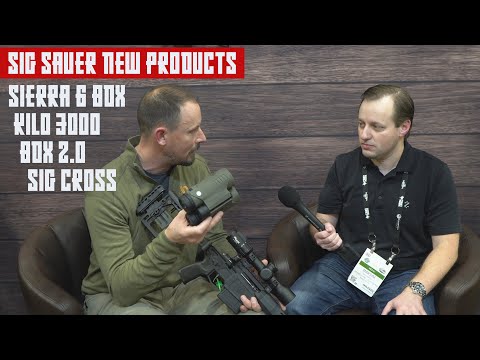
What’s up Squat Squad, and welcome to Slav Guns. This one is another throwback to SHOT Show 2020. I stopped by the Sig Sauer booth and caught up with Peter to talk about the new BDX 2.0 system, the Sierra6 BDX riflescopes, the Kilo3000 BDX binoculars, and the brand new Sig Cross rifle.
Quick note: this is a booth walkthrough, not a range test and evaluation. Prices and timelines below are what Sig quoted at SHOT Show 2020, so check current pricing before you buy.
TL;DR
- New Sierra6 BDX scopes with a 6x erector in 2-12x, 3-18x and 5-30x.
- Thinner reticle lines, more holdover dots, windage reference points, and 196 lit BDX holds (up from about 96).
- 34mm tube and much more travel: about 120 MOA on the 2-12x, versus about 40 MOA on the old 6-20x Sierra3.
- Bluetooth antenna moved to the top of the scope for better connectivity.
- BDX 2.0 adds a quick-bond pairing without a phone and ballistic groups 1 through 8 so you can get on paper without knowing every load detail.
- Quoted 2020 pricing: scopes about $1,199 to $1,499, Kilo3000 binos about $1,299, Cross rifle about $1,700.
Why I’m a BDX fan
I’ve done a few videos on the original Sig BDX system, and you know how much I love it. I’m a millennial, I love technology, and I love long-range shooting. What BDX does is take a brand new shooter who’s curious about precision long range but maybe intimidated or doesn’t have the skills yet, apply technology to proven optics, and break down the barriers to entry. The original had a few quirks. Sig fixed them and added more.
Sierra6 BDX riflescopes
The previous Sierra3 BDX line used a 3x erector, in 2.5-8x, 4.5-14x and 6-20x. The new Sierra6 platform uses a 6x erector and comes in 2-12x, 3-18x and 5-30x.
Sig listened to the feedback on reticles. A common complaint on the original was that the stadia lines were a little thick. For a second focal plane scope I didn’t think it was bad, but the new reticle is thinner, has more holdover dots, and adds windage and elevation reference points. If you love Christmas tree reticles, this is it. The surrounding bezels are also thinner, so you get a cleaner view.
The tube is now 34mm, and the Bluetooth antenna moved from the bottom to the top. Peter said some folks were seeing connectivity issues from thicker rings, and with the antenna on top they’re seeing connections out to roughly 15 to 25 yards. Yes, you could mess with your buddy’s scope a couple of lanes down. Sig won’t endorse that.
The big one for me is elevation travel. The BDX system could calculate holds well past 2,000 yards with a Kestrel or app, but the old 6-20x only had about 40 MOA of internal adjustment. Out to around 800 yards that wasn’t an issue, but it limited extended long range. The new 2-12x gets about 120 MOA. The illuminated BDX holds also went from around 96 to 196. Honestly, everything I might have disliked about the first generation looks fixed here.
BDX 2.0: no phone required
BDX 2.0 is aimed at people who don’t want to mess with a phone. There’s a quick-bond procedure: set the scope’s brightness to 1, press and hold the rangefinder’s mode button for three seconds, and it pairs with the closest scope.
Sig also broke calibers into ballistic groups 1 through 8. A lot of shooters know their caliber but not their exact bullet, BC and muzzle velocity. Pick your group in the rangefinder menu and it gives you a generic ballistic profile as a starting point. So you can buy it, go to the range, pair it, pick a group, and shoot. As you get more comfortable, you can go into custom profiles and true your muzzle velocity and BC.
Kilo3000 BDX binoculars
I’ve been eyeing the Kilo3000 BDX binos. Peter called them absolute little machines, and he said you’ll see them in a lot of PRS competitors’ kits. They give you ballistics on their own, and can also connect externally to a Kestrel 5700 Elite or a Garmin Foretrex. In a previous video I paired the system with a Kestrel 5700 and went from 800 yards out to around 2,400.
Quoted price was around $1,299 to $1,300. That sounds like a lot if you shop $100-$200 entry-level binos, but high-end glass from Leica, Swarovski or Leupold easily runs two to three thousand or more. I looked through these and the glass quality is really nice. Peter said three years earlier a pair of ranging binos ran them about $8,000, without the BDX tech built in.
Sig Cross rifle
The new optics were mounted on the brand new Sig Cross. It’s Sig’s own design with a one-piece machined aluminum receiver, AICS-pattern mags, and a custom two-stage trigger. The folding stock locks in place, and both the comb and the butt plate are fully adjustable and lock where you set them. Grips are swappable, and Peter mentioned the stock may end up being able to fold either way. Up front is an M-LOK forend with a top rail.
Chamberings at the show: .308 and Sig’s .277 Fury with 16-inch barrels, and 6.5 Creedmoor with an 18-inch barrel. Weight is about six and a half pounds. It’s aimed at hunters first: compact, comfortable, light, and designed to ride in a backpack, though PRS shooters can add weight and run it in competition. The barrel is threaded, so yes, you can be polite and shoot suppressed.
Quoted pricing was about $1,700, with production targeted for March and rifles on shelves around June or July 2020.
Bottom line
As a precision rifle shooter, I’m freaking excited about BDX 2.0. Sig took something that already worked, fixed the quirks, and made long range more approachable for anybody. If you’re in the market for glass, check current deals through slav.li/amazon, and if you want to support the channel, join the channel.
Keep squatting.
Would you trust a BDX setup for your first long-range rig? Let me know.
Some links are affiliates.
Comments