

What’s up, channel fans and family, and welcome back to Slav Guns. This one comes from my SHOT Show 2020 coverage, at a booth that’s very familiar to a lot of precision shooters: Sierra. I sat down with Adam Bell to go over what Sierra had new for 2020, and then I went off script and picked his brain about bullet tips, load data and why Sierra shoots 10-shot groups.
If you’ve been shooting for a while, and especially if you hand load, you know the Sierra MatchKing. It has pretty much been the gold standard for precision shooters for years. But Sierra isn’t just a bullet company anymore. They’ve been building out loaded ammo too, and that was the big story at the booth.
Quick note: this is a SHOT Show booth interview, not a range test and evaluation. Products, prices and availability are what Adam told me at SHOT 2020, so check what’s current before you buy.
TL;DR
- Three ammo lines: GameChanger (hunting), Prairie Enemy (varmint, new for 2020), and a new match line with True Velocity polymer cases, starting in 308 Winchester.
- Prairie Enemy: Loaded with BlitzKing bullets. Adam ballparked the price in the mid-$20s, and said it was in stores like Academy and Bass Pro.
- New bullets: Including a 100-grain Tipped GameKing for long-range hunting with 6 Creedmoor and other 6mm cartridges.
- 6.5 PRC picks: The 150-grain or 142-grain MatchKing.
- 300 PRC picks: The 200-grain or 230-grain MatchKing.
- Tips vs. closed nose: Adam’s take is that both shoot the same. What matters is bullet-to-bullet consistency, and a tip is one more thing that has to be put in right.
- Testing: Sierra shoots 10-shot groups, usually ten of them, through at least two guns.
Sierra’s three ammo lines
GameChanger: hunting ammo
Sierra had been growing the GameChanger line since the year before. It’s their hunting ammo, loaded with their hunting bullets, and Adam gave me their tagline for it: they “fly like MatchKings and hit like GameKings.” The idea is best-in-class flight performance and best-in-class terminal performance in one box.
Prairie Enemy: new varmint ammo
New for 2020 was Prairie Enemy, Sierra’s varmint line. It’s loaded with their BlitzKing bullets, which are known for being devastating on varmints, and it’s priced to be more economical. Adam went through loads for .223, .224 Valkyrie (a 69-grain load), .204 Ruger and .243.
When I asked about price, Adam said it should be around the mid-$20s, in line with other economy varmint ammo. Sierra’s goal was to bring their kind of accuracy to a varmint line. He said Prairie Enemy and all the GameChanger loads were available right then, at places like Academy and Bass Pro.
A match line with True Velocity polymer cases
This was the one that made me raise an eyebrow. Sierra was teaming up with True Velocity on a match line using True Velocity’s polymer cases, starting with 308 Winchester. If you were at SHOT that year, you saw True Velocity’s name everywhere.
So what’s the point of a polymer case? Adam said it’s all about manufacturing control. They can closely control the outside and inside geometry of the case and tune it for the best load. They can also tune neck tension, which really drives down standard deviations in both velocity and pressure. Low SDs are how you get those sub-MOA groups. I’ll admit I was curious enough to want to try some.
New bullets for reloaders
For the hand loaders, Sierra had new bullets in 6mm, 6.5mm and 308. The one Adam called out was a 100-grain Tipped GameKing (TGK). It’s a great fit for the 6 Creedmoor if you want to do some long-range hunting. Sierra loads it in their own ammo, but you can buy the bullets and load them in other 6mm cartridges too.
Extended-range hunting, 6.5 PRC and 300 PRC
One trend Sierra was seeing was extended long-range hunting, especially out West. That’s a big part of why cartridges like the 6.5 PRC and 300 PRC were coming to market. By then I had looked at four or five rifles in those calibers, and they had been phenomenal.
The way I look at it, the 6.5 PRC is kind of a 6.5 Creedmoor Magnum. The 300 PRC takes the good parts of 300 Win Mag and 300 Norma Mag and fixes what was wrong with them. I was about to start hand loading both, so of course I asked what bullets Sierra recommends.
- 6.5 PRC: For match shooting, Adam recommends the 150-grain MatchKing or the 142-grain MatchKing. High BCs and very reloadable. He agreed with my 6.5 Creedmoor Magnum comparison and said the cartridge is designed with the right proportions, so you can put pretty much any bullet you want in it and it’ll do well.
- 300 PRC: Adam said they fixed all the old problems and opened up the cartridge, so you can run long, low-drag bullets like the 200-grain MatchKing and the 230-grain MatchKing, and they run much better.
On load data, Adam said Sierra had 6.5 PRC data for almost a year, in the manual and in the Sierra app. 300 PRC was in the works: barrel chambered, brass in hand, loads underway.
If you want to see how these cartridges shoot in factory rifles, check my Ruger Hawkeye Long Range Target 6.5 PRC review and my Ruger Precision Rifle 300 PRC review.
Do your bullets need tips?
I hadn’t scripted this part. One big trend in bullet design has been moving from the classic hollow point boat tail to bullets with a finished meplat (the tip of the bullet). Some companies use an aluminum tip, others a polymer tip. So which is better?
Adam said it’s mostly about what flavor you like. For Sierra, whether they put a tip in or close the nose, the accuracy and precision come out the same. What they really focus on is bullet-to-bullet consistency. With a tip, the question is how well each tip went in. With a closed nose, Sierra’s manufacturing lets them make very uniform meplats, and that consistency cuts down on fliers. You can still get that with a tipped bullet, but the tip is one more thing in the mix that can go wrong.
I also asked the practical question. At the 500-600 yards that 99% of gun owners will ever shoot, it probably won’t make a difference. So don’t feel like you have to pay extra for a tip just because the box looks cooler.
Why Sierra shoots 10-shot groups
Another Sierra employee had told me Sierra doesn’t test with three- or five-shot groups. They shoot 10-shot groups. Adam said they usually shoot ten 10-shot groups, depending on how much ammo they have, and always through at least two guns. That’s how they make sure the ammo lives up to the Sierra name.
That hits one of my pet peeves with gun media. Someone calls a gun accurate after shooting a few three-shot groups. Anybody can get a lucky three-shot group. My minimum is five.
Adam’s answer was that the group size should fit the purpose:
- Ammo qualification: Sierra shoots 10-shot groups because they’re qualifying large amounts of ammo that has to work in lots of different guns.
- A hunting rifle: Three to five shots and he’s happy. You won’t see the fliers you would with a match gun.
- F-Class: A 20-shot string.
- A PRS gun: Shoot it like a PRS stage. Maybe skip the barricades, but sit at the bench and run them as fast as you can get back on target. That shows whether all that heat in the barrel in a short time moves your impacts.
In other words, train how you’re going to compete, or how you’re going to protect yourself. I can’t argue with that.
Bottom line
Sierra in 2020 was more than MatchKings. GameChanger for hunters, Prairie Enemy for varmints, and a polymer-cased match line with True Velocity showed a company pushing hard into loaded ammo. For reloaders, the 150 and 142 MatchKings for 6.5 PRC and the 200 and 230 MatchKings for 300 PRC are a good place to start. And the best takeaway was the simplest: tip or no tip, consistency is what shrinks groups, and you should test your rifle the way you’ll actually use it. Thanks again to Adam for letting me pick his brain.
The reloading and range gear I use is on slav.li/amazon. Want member perks? Join the channel here.
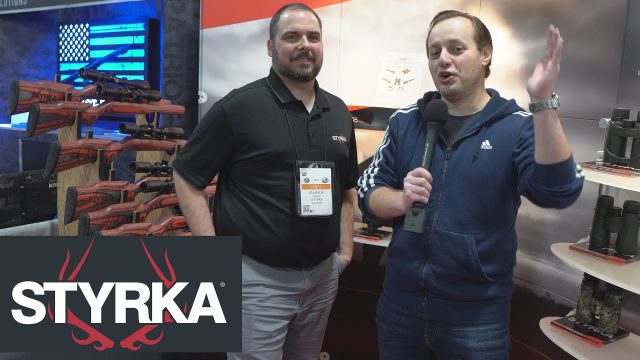
More from SHOT Show 2020: Styrka booth tour, Episode 0: Slav Guns Goes to Vegas and Media Day at the Range.
Keep squatting.
Three-shot, five-shot, or 10-shot groups: what do you trust when someone calls a rifle accurate? Drop it in the comments.
Some links are affiliates.

Comments