

Hey there, Squat Squad, and welcome back to Slav Guns. Ever since it came to market, the Ruger Precision Rifle has been the standard for factory precision rifles. In modern calibers like 6.5 Creedmoor, 6.5 PRC or 300 PRC, a factory gun with factory ammo can shoot sub-MOA. But what if you want to go consistently sub half MOA? That’s where it takes more work, more money, and accessories like the one I’m covering today: the Adjustable Bag Rider (ABR) from Long Shot Precision.
I mentioned the ABR in my five upgrades for the Ruger Precision Rifle video, but this is the deep dive: what it does, how it installs, and what happened to my groups at 330 yards with and without it. This one I actually shot on the range, back in June 2020.
Disclosure: The Adjustable Bag Rider was provided by Long Shot Precision for testing & evaluation. Long Shot Precision did not see this video prior to publication.
More info and install instructions: adjustablebagrider.com. Rear bags, rests and the rest of the gear I use: Slav Guns storefront on Amazon.
TL;DR
- What it is: a precision-made, micro-adjustable bag rider that replaces the lower rail section of the stock Ruger Precision Rifle stock. There’s also a Picatinny version for other stocks and chassis.
- What it does: you set the rifle on your rear bag and dial the wheel to put the scope on target. No more squeezing the bag, which cuts vertical dispersion. Pair it with the matching Protektor bag and you cut horizontal dispersion too.
- My results: bone-stock RPR in 6.5 PRC at 330 yards, average 5-shot groups went from 2.68″ without the ABR to 2.094″ with it. That’s about a 20% improvement, mostly in vertical.
- Who it’s for: F-Class shooters and Ruger Precision Rifle owners who want tighter groups without paying for a big adjustable front rest.
Where precision actually comes from
When it comes to precision, there are three places you find the variables: the firearm itself, the ammunition, and your shooting ability. Precision shooting is all about reducing those variables. The easiest one to work on, and the one that makes the biggest difference, is of course you. That’s why I’m amused but not surprised when people complain about accuracy problems and blame the gun without first examining themselves.
The ABR is an accessory that helps on the shooter side. Simply put, whatever your shooting abilities are today, it reduces the stuff that opens up your groups. The very first time I used one, I shot a sub-0.8″ three-shot group at 300 meters with a factory bone-stock Ruger Precision Rifle in 6.5 PRC and factory ammo.
How it works and how it installs
The ABR replaces the bottom rail piece of the RPR stock. Installation is a few bolts to pull the stock piece off and put the bag rider on. It comes with instructions in the box, and they’re also online. In the video I swapped it over from my other Ruger Precision Rifle right there at the bench, and it takes about as long as it sounds.
- Adjustment wheel: a wheel at the front raises or lowers the lower section that rides on the bag.
- Two bottom cuts: square bottom or V-shape, depending on the bags you already have. I picked the square bottom so I can use it on the Protektor bag at the range, or on other shooting bags out in the field.
- Prone option: there’s an optional piece that raises the cheek height of the recoil pad, and it works with the stock LimbSaver pad.
The way it reduces vertical dispersion is that it removes the need to squeeze and hold your rear bag. You put the bag rider on the bag, use the micro adjustment wheel to raise or lower the back of the rifle until the scope is on target, and then you leave it alone. Focus on trigger discipline and your shooting position, and let the gun do its thing.
Not shooting a Ruger Precision Rifle?
By popular request, Long Shot Precision designed a version that attaches to a Picatinny rail on the bottom of your stock. It works the same way and accomplishes the same goal, but fits a lot more rifles and chassis systems. I have it mounted on the FAB Defense RAPS (Rapid Adjustable Precision Stock), so if your rifle uses an AR-15 style buffer tube, you can run that stock and this version of the bag rider.
Range test: with and without the ABR at 330 yards
The rifle was the same Ruger Precision Rifle in 6.5 PRC from my last video: stock action, stock barrel, stock trigger. The only changes were the Catalyst Arms extended Hammerhead bolt knob and extended magazine release. And I’ll say it again, that extended bolt knob from Catalyst Arms is fantastic. I warmed the barrel up on steel at 330 yards first, then shot paper with factory Hornady ELD Match.
Without the ABR
The stars aligned and I shot a 1.96″ five-shot group, which is 0.56 MOA. Most of that dispersion was vertical, exactly what the ABR is supposed to fix. Horizontal was only 0.4″. (Yes, I had dialed the scope the wrong way at first, which is why I was shooting into the triangles. It happens.)
With the ABR
- First group: also 1.96″, but vertical dispersion was only 1″. The ABR was clearly doing its job there. The horizontal spread could have been me pulling shots or the wind. It’s 330 yards and there was some wind.
- Second group: my best three-shot and four-shot group I’d ever shot at that distance, and then I slightly ruined it. Three shots measured 0.8″. The fourth took it to 1.04″, or 0.3 MOA. The fifth made it 1.64″, or 0.47 MOA, which I suppose is still good. You can watch me making micro adjustments with the wheel during this group, which is exactly what it’s built for.
- Two more groups: 2.5″ and 2.8″. I was getting tired and my groups picked up a bit, so I took a break.
- Final group, Hornady Precision Hunter 143 gr ELD-X: I stood behind the gun this time because my foot was getting tired sitting. That one was a 1.57″ five-shot group, 0.45 MOA, with me pulling one shot.
Overall, my average five-shot group at 330 yards was 2.094″ with the ABR versus 2.68″ without it, a difference of about 20%. The biggest change was vertical dispersion, where groups got much tighter.
One honest caveat: after filming I discovered my rear bag was slightly out of spec, which allowed more horizontal dispersion than there should have been.
What impresses me most is that this came out of a bone-stock gun. I’m sure with a Timney or a Jard trigger, and shooting prone, we could push it toward the 0.2 MOA range, or at least lose those flyers on the fourth and fifth shots.
Why not just buy an adjustable bipod or a cheap monopod?
If you’ve watched or shot benchrest or F-Class, you’ve seen those crazy adjustable front rests like the Joy-Pod, which as I said in the video easily cost $500 or more. The ABR gets you similar adjustment ability at a far lower price by moving the vertical adjustment from the front of the gun to the rear.
There are cheaper rear monopods and bag riders out there, but they’re still wobbly and don’t give you straight-back tracking. With the ABR you can actually see your bullet impacts, assuming you’re not shooting a big magnum at close distance. And you can shoot comfortably for a lot longer without your hand getting tired of squeezing the bag.
Bottom line
Whether you’re an F-Class shooter looking to compete at the top levels, or you’re a Ruger Precision Rifle owner who just wants better groups, the Adjustable Bag Rider is seriously worth looking into. On a bone-stock RPR it took my average groups down about 20%, mostly by killing vertical stringing.
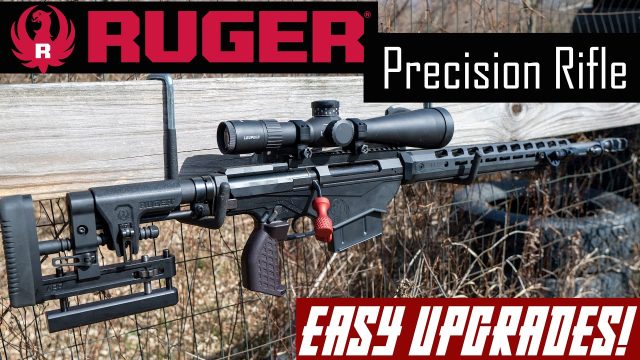
More on this rifle and platform: my Ruger Precision Rifle 6.5 PRC review, the Ruger Hawkeye Long Range Target 6.5 PRC, and my list of best Ruger Precision Rifle upgrades.
Want more precision rifle content? Join the channel.
Keep squatting.
Do you squeeze the bag or run an adjustable rear rest? Tell me in the comments.
Some links are affiliates.
Comments