

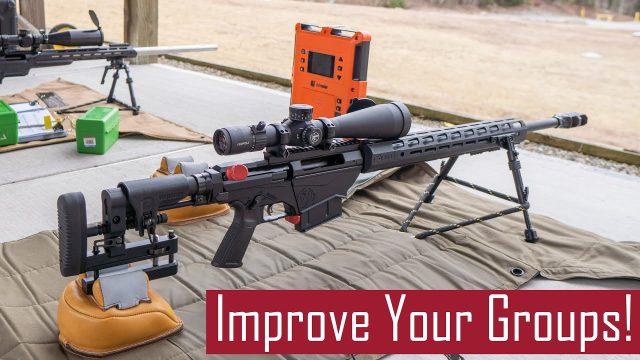
Hey there, channel fans and family, and welcome back to Slav Guns. Despite being a handgun guy, I have really fallen in love with long-range shooting, and with the Ruger Precision Rifle in particular. It’s mind-blowing what a stock RPR can do. In my earlier videos I shot the Ruger Hawkeye Long Range Target and the Ruger Precision Rifle in both 6.5 PRC and 300 PRC out to 1,600 yards and beyond, all with factory guns and factory ammo.
Since its introduction, the Ruger Precision Rifle has disrupted the idea that you need a custom gun to consistently shoot sub-MOA groups. In a sense, it has become the Glock of the precision rifle world. You don’t need to spend money to make it shoot. You can, however, spend just a little bit to make it shoot that much better. Here are five free or low-cost upgrades that don’t need a gunsmith.
Quick note on what this is: it’s an accessory walkthrough on my 300 PRC RPR, filmed in spring 2020, not a range test with groups on paper. The full range test of one of these parts is linked below.
Disclosure: The firearm was provided by Ruger for testing & evaluation. The pistol grip, extended bolt knob and magazine release, Ruger Kestrel and Adjustable Bag Rider were provided by the companies. The companies did not see this video prior to publication.
Where to get them: Anarchy Outdoors Tuxedo Grip (use code SlavGuns), the Catalyst Arms Hammerhead bolt knob, and the Catalyst Arms extended magazine release.
TL;DR
- Handling upgrades: Catalyst Arms extended bolt knob and extended magazine release. They won’t make the gun more accurate, but they make running it a lot nicer.
- Accuracy upgrades: the Anarchy Outdoors Tuxedo precision grip and the Adjustable Bag Rider from Long Shot Precision.
- Long-range must-have: a ballistic calculator. Either a Kestrel 5700 (I used the Ruger Edition) or a free app on your phone.
- Install: everything here goes on at home with basic tools. No gunsmith.
1. Catalyst Arms extended bolt knob
The first thing you’ll probably notice on this 300 PRC Ruger Precision Rifle is the extended bolt knob. The RPR is a production gun. All the parts come from the production line and get assembled into a working rifle. Nobody is hand fitting parts, and the precision comes from the manufacturing process. As a result, bolt manipulation isn’t going to feel like a higher-end or custom gun, like something built by GA Precision.
The Catalyst Arms Hammerhead extended bolt knob replaces the smaller stock knob and gives you more leverage to work the bolt. It won’t make the gun more accurate, but it will improve the experience of running the bolt. The other benefit is that it can save your fingers and knuckles if your scope rings or scope mount stick out to the side, because it gives you more clearance.
When I filmed this, it sold for $35 and came in three colors: boring black, slightly less boring gray, and the red I have, which matches my Adidas tracksuits. To install it, unthread the stock knob, apply a dab of Loctite, and screw on the new one. Done.
2. Catalyst Arms extended magazine release
The second handling upgrade also comes from Catalyst Arms. Their extended magazine release attaches to the stock mag release with just one bolt, and it makes the release accessible from both sides. You simply push forward with the trigger finger on your strong hand, whether you’re a righty or a lefty.
It’ll save you time if you’re reloading on the clock, and even if you’re not competing, it makes removing and changing magazines more pleasant. Like the bolt knob, it came in black, gray and red, and sold for around $30 at the time. Align it on top of your stock mag release, attach it with the bolt, and you’re done. No gunsmithing experience necessary. Catalyst Arms also had a combo kit that saved you $10 if you bought both the bolt knob and the mag release.
3. Anarchy Outdoors Tuxedo precision grip
The next two upgrades will actually improve your accuracy. If you’ve watched my previous shooting videos or other precision rifle shooters, you may have noticed them keeping their thumb on the strong side of the gun rather than wrapped around the grip. That’s the opposite of how you’d shoot a handgun or a modern sporting rifle. The reason is that with your thumb on the strong side, you’re more likely to pull the trigger straight back instead of pulling or jerking it to one side.
The Tuxedo grip from Anarchy Outdoors was built for precision shooters for exactly that purpose.
- Thicker, completely upright body: keeps your bottom three fingers parallel to the trigger and to the recoil movement.
- Thumb shelf: the biggest feature is the shelf for your thumb on the strong-hand side.
- Not ambidextrous: but don’t worry, lefties, there’s a version for you too.
It may take a little getting used to shooting with your thumb on the strong side, but with this grip you get a better trigger pull with less stress on your fingers and wrist.
4. Adjustable Bag Rider from Long Shot Precision
The other upgrade with a real impact on accuracy is the Adjustable Bag Rider from Long Shot Precision. It replaces the bottom rail section of your stock Ruger Precision Rifle stock and creates a stable platform. Combined with a good rear bag (not like the one I have in the video), it lets you make micro adjustments to your sight picture with no changes to your body position and no need to squeeze the bag. Both of those introduce vertical dispersion.
With the Adjustable Bag Rider, I shot a sub-0.8″ group at 300 yards with the factory barrel and factory match ammo. I liked it so much I did a full range test with and without it, and you can read that here: Adjustable Bag Rider Review: Tighter Ruger Precision Rifle Groups at 330 Yards.
5. A ballistic calculator
The last upgrade is a ballistic calculator of some sort. After all, this is a Ruger Precision Rifle, and shooting it at 100 yards is like buying a Ferrari and driving it to the grocery store. These guns beg to be shot at 1,000 yards and beyond. If you’re going to take long range seriously, you’ll want an all-in-one device that combines a ballistic calculator with the ability to capture your environmental conditions.
The one I have is the Kestrel 5700 Ruger Edition. It captures wind speed, direction, crosswind, temperature, humidity, pressure and altitude, everything you need for the most precise firing solution. You combine that with your gun’s variables, like the bullet you’re shooting and its velocity, and the Kestrel gives you the solution.
- Ruger profiles: what makes this Kestrel unique is that it comes preloaded with shooting profiles for various Ruger rifles and match-grade bullets, so someone new can get started quickly.
- LiNK Bluetooth: it works with the Kestrel app on your phone and with LiNK-enabled devices like rangefinders that feed the target distance straight to the meter.
- Applied Ballistics vs. Hornady 4DOF: most Kestrel ballistics units run the Applied Ballistics engine. If you prefer Hornady 4DOF, there’s a Kestrel 5700 4DOF meter too, but it doesn’t come preloaded with the Ruger rifle profiles.
The really cool integration was running the Ruger Kestrel 5700 with the Sig Sauer BDX system to shoot at 1,000 yards. All we had to do was range the target with the Sig KILO rangefinder, which fed the distance to the Kestrel. The Kestrel found the firing solution and sent it to the Sig Sierra3 BDX scope, which lit up the holdover in the reticle. Super cool.
The downside is that these meters were about a $300 to $400 investment when I made this video. If you want a ballistic calculator and can’t get a Kestrel yet, use your phone. On Android you have a number of choices, including the Hornady 4DOF and Lapua ballistics apps, both free. On iPhone or iPad you also have the Ballistic app, which used to be a paid app and became free. Besides the calculator, it adds a heads-up display, a rangefinder feature and a shooting log.
Bottom line
The Ruger Precision Rifle already shoots. These five upgrades just make it shoot a little better and feel a lot better: a bolt knob and mag release for handling, a proper precision grip and an adjustable bag rider for accuracy, and a ballistic calculator so you can actually stretch it out where it belongs.
More on this rifle: my Ruger Precision Rifle 300 PRC review, the Ruger Precision Rifle 6.5 PRC review, and my list of best Ruger Precision Rifle upgrades with Anarchy Outdoors.
Want more precision rifle content? Join the channel.
Keep squatting.
What was the first upgrade you put on your RPR? Tell me in the comments.
Some links are affiliates.
Comments