
Results in this article are unofficial as of the afternoon of Wednesday, Nov. 4, 2026. Several races were still uncalled, and they are marked as such below.
Tuesday night was not close. Democrats took both chambers of Congress, flipped five governorships in states Trump carried in 2024, and turned over legislatures from Wisconsin to New Hampshire. For gun owners the big question is not who gets to give speeches in D.C. It’s what lands on governors’ desks when state sessions open in January, and whether anything federal actually moves with Trump still holding the veto pen.
Below: what flipped, which states can actually pass gun laws now, the federal wildcard, what history says about buying surges, and how gun stocks are reacting. Facts are sourced. Our opinions are labeled as our take.
What Flipped in the 2026 Midterms
Federal first. Democrats will control the House and Senate in January. The Senate stands at at least 54 Democratic seats, with Alaska and Mississippi still unresolved per CBS News. In the House, PolitiFact counted 233 Democratic seats called as of midday Nov. 4, and NBC projects at least 258. Either way, it’s nowhere near the 290 House votes and 67 Senate votes needed to override a veto.
The states are where it gets real for gun law. Here’s the map, based on reporting from NCSL, the DLCC results tracker, Stateline, AP and NBC:
| State | What changed | Governor | Who can pass gun bills now? |
|---|---|---|---|
| Full Democratic control (trifecta) | |||
| Wisconsin | Both chambers flipped R to D | David Crowley (D) | Democrats, start to finish |
| Pennsylvania | Senate flipped to D | Josh Shapiro (D) | Democrats |
| Michigan | House flipped to D | Jocelyn Benson (D) | Democrats |
| Minnesota | House flipped to D | Amy Klobuchar (D) | Democrats |
| Nevada | Governor flipped to D; legislature already D | Aaron Ford (D) | Democrats, with no GOP veto left |
| Arizona (uncalled) | Both chambers projected D by DLCC and Stateline; NCSL still treats the Senate as pending | Katie Hobbs (D), leading | Democrats, if the calls hold |
| Virginia | No legislative race this year; already full D control | Abigail Spanberger (D) | Democrats (assault weapons ban already signed) |
| Split control | |||
| New Hampshire | Both chambers flipped R to D | Kelly Ayotte (R), reelected | Nobody alone. Ayotte can veto |
| North Carolina | House flipped to D; Senate still uncalled per DLCC | Josh Stein (D), not up | Gridlock |
| Georgia | House flipped to D; Senate stays R | Keisha Lance Bottoms (D), flipped | Gridlock; governor can veto pro-gun bills |
| Texas | House flipped to D, first time since 2002; Senate stays R | Gina Hinojosa (D), flipped | Gridlock; governor can veto pro-gun bills |
| Governor flips with a Republican legislature | |||
| Ohio | GOP keeps legislature; Democrats broke the House supermajority | Amy Acton (D), flipped | Republicans, but Acton’s vetoes can now stick |
| Iowa | Legislature uncalled | Rob Sand (D), flipped | Depends on final legislative calls; Sand has a veto |
Still open as of this writing: governor races in Kansas (Democrat Cindy Holscher led 50.3% to 49.7% with about 98% counted) and Alaska, plus final calls on Arizona, the North Carolina Senate and the Iowa legislature. Counts can shift, so treat this table as a snapshot, not gospel.
The Gun Law Push to Expect in 2027 Sessions
A trifecta is what matters. When one party holds the House, Senate and governor, bills don’t just get introduced. They get signed. Here’s what’s on the table based on what’s already been filed or campaigned on:
- Pennsylvania: With the Senate flipped for the first time since before the 1994 elections, The Trace reported that expanded background checks, red flag laws, and bans on machine gun conversion devices and ghost guns are the likely agenda. Pennsylvania is a top-five state for NSSF-adjusted background checks, so this is a big market.
- Minnesota: Democrats plan to bring back assault weapons and magazine restrictions that stalled in 2026. Incoming U.S. Sen. Peggy Flanagan campaigned on banning “assault weapons” and “high-capacity magazines”.
- Michigan: A 10-round magazine limit bill (HB 5750) is already in the hopper. It has not passed. With the House flipped, it now has a path.
- Wisconsin: This is the first time in years that Democrats run the entire process in Madison. Our take: expect universal background check and red flag bills early in the session. Wisconsin was a top-five state for long gun checks in October.
- Virginia: The assault weapons and 15+ round magazine ban (HB 217/SB 749) was signed in May 2026 but is blocked by court injunctions while lawsuits proceed. Virginia is the test case everyone else is watching.
- Nevada and Arizona: Nevada loses its Republican veto, and Arizona would too if the legislative calls hold. Our take: both become states to watch for new bills.
In Georgia, Texas, Ohio and Iowa, the new Democratic governors can’t pass gun control on their own because Republicans still control at least one chamber. What they can do is veto pro-gun bills. The practical effect is that gun law expansion stalls there. That’s a real change, but it’s not the same as a ban heading your way.
New Hampshire: The Live Free or Die Firewall
New Hampshire got the biggest swing on paper. Democrats flipped both chambers and won a supermajority in the 400-seat House. AP projected a 15-9 Senate, which is “just shy of a veto-proof majority” according to NHPR. But Republican Gov. Kelly Ayotte won reelection about 51% to 47%. A veto override takes two-thirds of both chambers, and the Senate doesn’t have it.
That matters because New Hampshire is gun country. Permitless carry has been law since Feb. 2017. The state is home to SIG SAUER’s Newington headquarters and Exeter plant and Ruger’s Newport plant, which employed about 1,200 people as of 2017. As long as Ayotte holds the veto and the Senate can’t override, permitless carry is safe. Our take: expect bills that test her anyway, and expect them to be messaging bills for 2028.
The Federal Wildcard: Would Trump Cut a Gun Deal?
Conventional wisdom says nothing federal happens. Democrats can pass a universal background check bill or an assault weapons ban, and Trump vetoes it. Trump literally posted a “Veto” hat on election night.
But in the same PolitiFact piece, he told outlets his administration will “work with the Democrats” and that he “doesn’t want to be just sitting there for two years vetoing everything.” So here’s our take, and it is speculation: a Trump who needs things from a Democratic Congress, whether that’s his own priorities or protection from investigations, could trade gun policy to get them. He has done it before.
- Bump stocks, 2018. After Parkland, Trump ordered DOJ to ban bump stocks, and the rule was issued Dec. 18, 2018. No Congress needed.
- “Take the guns first, go through due process second.” That’s what he said at a Feb. 28, 2018 White House meeting, where he also floated raising the purchase age and praised the Manchin-Toomey background check bill.
- El Paso and Dayton, 2019. He tweeted for “strong background checks,” possibly paired with immigration reform, then backed away within about two weeks and pivoted to red flag laws.
- The 2022 template. The Bipartisan Safer Communities Act passed with 15 Republican senators. It funded $750 million in state crisis and red flag programs and added enhanced checks for buyers ages 18 to 20.
What a deal could look like, if one happens: more red flag money, expanded background checks along the lines of H.R. 18, and maybe an age-21 rule for some semi-auto rifles. On the other side of the table, the trade bait could be the SHORT Act or Hearing Protection Act. The $200 NFA tax on suppressors and SBRs already went to $0 on Jan. 1, 2026, but registration still applies.
Reasons for doubt are real too. Democrats have 54 Senate seats, not 60, so a filibuster still requires Republican votes. Several of the Republicans who voted for BSCA are gone: Cornyn, Cassidy, Ernst, Tillis and Collins. Trump also reversed himself fast in 2019. Our rough read is that gridlock is still the most likely outcome. But there’s a meaningful chance, call it four in ten, of months of serious federal gun talk. History says that alone moves buyers nationwide.
What History Says About Buying Surges
Gun owners have played this movie before. Using NSSF-adjusted NICS checks (not a perfect sales count, but the best public proxy):
- Virginia, 2019 to 2020. After Democrats won full control in Nov. 2019, Virginia gun sales soared ahead of the session. estimated December sales were up 47% from the year before, and January 2020 checks were up roughly 85% year over year. That’s the closest match to what PA, WI, MI and MN are facing now.
- 2012 to 2013. After Obama’s reelection and Sandy Hook, December 2012 adjusted checks hit about 2.24 million, up about 59% from the year before. 2013 then set a record of about 14.8 million, even though the federal assault weapons ban and Manchin-Toomey both failed. The push alone did it.
- 2020. COVID, unrest and an election produced an all-time record of about 21.1 million adjusted checks, up about 60%.
- The Trump slump. After Trump won in 2016, Smith & Wesson and Ruger shares fell 10% to 12% the next morning, and 2017 adjusted checks dropped about 11%. After 2024 it was slower, with adjusted checks in 2025 down about 4%.
Where things stand now: October 2026 adjusted checks were 1,402,422, up 7.9% year over year. The Reload called it the best post-pandemic October, behind only 2020 and 2021. Ammo was moving before the vote too. Korean maker Poongsan told investors U.S. buyers were stockpiling ahead of the midterms.
Gun Stocks After the Blue Wave
Not financial advice. We’re a gun channel, not your broker. Numbers below are dated and sourced, and prices were intraday snapshots from stockanalysis.com around 1 to 2 p.m. ET on Nov. 4, 2026.
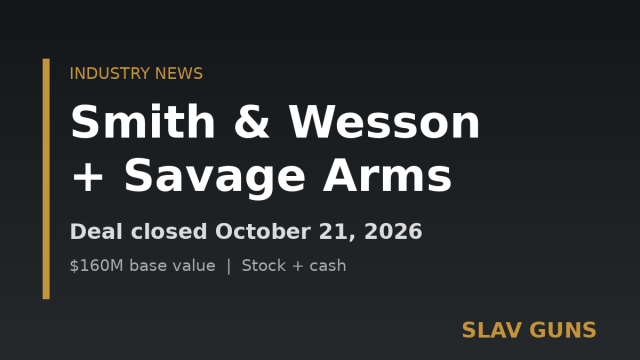
- Smith & Wesson (SWBI): Up about 9% intraday on election day. Its last quarter, ended July 31, showed sales of $112.6M, up 32%. That included a one-time tariff refund that helped margins. The company guides to second-quarter sales about 10% higher and full-year growth of 5% to 7%, and pays a $0.13 quarterly dividend. It also closed the Savage Arms deal Oct. 21. Our take: the most direct handgun and MSR play on a fear cycle, now with more hunting rifles in the mix.
- Sturm, Ruger (RGR): Up about 8% intraday, then reported Q3 after the close. Sales were $147.6M, up 16.5%, well above the roughly $131M analyst estimate. GAAP EPS was $0.36 versus a $0.37 estimate, and adjusted EPS was $0.44. Ruger has no debt and $101.4M in cash, declared a $0.18 dividend, and is suspending some low-margin product families worth about $25M in revenue. Beretta now owns about 25% after a $44.80-per-share tender. Our take: the quality name, but the stock already ran hard this year.
- Outdoor Holding (POWW), owner of GunBroker: It earns on transactions, including used guns. When demand spikes, marketplace volume usually follows. Our take: higher risk and pricier valuation, but a pure play on volume.
- Sportsman’s Warehouse (SPWH): Had the most upside in the last surge, with fiscal 2020 sales up 63.8% and same-store sales up 48.3%. Today it’s a different story. Its latest quarter showed flat same-store sales, firearms up 8% and ammo up 11%, a net loss, and $167M of net debt. Its 147 stores are mostly out West, with 21 in PA, MI, MN, WI, VA and NC. Our take: lots of upside if a national surge happens, lots of risk if it doesn’t.
- Others: Olin (OLN) owns Winchester, whose Q3 sales rose to $484.7M, but chemicals and a pending Huntsman merger drive the stock. American Outdoor Brands (AOUT), Byrna (BYRN) and GrabAGun (PEW) are smaller, more company-specific stories. Federal, Remington, CCI and Speer sit inside privately held CSG, not a U.S. ticker.
The bear case deserves a fair hearing. State bans remove products from big markets once they take effect. A buying spike in 2027 borrows from 2028, and the 2014 and 2022 hangovers were real. Consumers are squeezed by higher prices, and if Trump simply vetoes everything, the national panic may never come.
What It Means for You
No panic buying required. But if you live in Pennsylvania, Wisconsin, Michigan, Minnesota, Virginia, Nevada or Arizona, a few practical things make sense:
- Buy what you were already planning to buy, on your schedule. If a particular rifle, pistol or magazine has been on your list, it’s reasonable not to wait until a bill is in committee. That’s when shelves get thin and prices go up, as Virginia showed. Sessions open in January.
- Know your state’s laws, and watch effective dates. Proposed bills change a lot between introduction and signing. Many include grandfather clauses, so read the bill, not the headline.
- Get involved. State 2A organizations testify, track bills and file lawsuits. Virginia’s ban is on hold in court right now because gun owners and groups sued. Join yours, show up at hearings, and call your state legislators. They hear from far fewer people than members of Congress do.
- Stock up on ammo sensibly. If you shoot regularly, buying a little extra each month beats paying panic prices later.
We’ll keep tracking the uncalled races and the 2027 bill filings as they drop. Tell us in the comments what’s happening in your state.
Disclaimer: This article is for informational and entertainment purposes only. It is not financial, investment, legal or tax advice, and it is not a recommendation to buy or sell any security. Election results are unofficial and stock prices change constantly. Do your own research and talk to a licensed professional.
Sources
- NBC News: Democrats capture full control of Congress
- NBC News: Democrats clinch a majority of governorships
- CBS News: 2026 Senate results
- PolitiFact: How might Trump use veto power?
- NCSL: 2026 state legislative elections results
- DLCC: 2026 election results
- Stateline: Democrats flipped legislatures and won trifectas
- NHPR: Ayotte secures reelection
- Boston Globe: NH Democrats break GOP trifecta
- NSSF-adjusted NICS, October 2026
- Ruger: Third quarter 2026 results
- ABC News: Timeline of Trump’s record on gun control
- Congress.gov: Bipartisan Safer Communities Act
Some links are affiliates.


Comments