

Loaner T&E: Vortex Optics provided this Strike Eagle 5-25×56 on loan for testing and evaluation. Vortex did not see the video before it went live. This review was filmed and published in November 2020, so read it as a look back at the launch-era 5-25 Strike Eagle — not a 2026 street-price roundup.
Channel fans and family, you dropped your entire load on a very nice rifle and still needed an optic that would not empty the rest of the safe. In late 2020 I finally sat down with the highly anticipated mid-priced Vortex Strike Eagle 5-25×56 FFP — the bigger brother to the LPVO Strike Eagles we still see in deals — and put it through features, glass, and turret checks on a precision-focused 6mm ARC build.
TL;DR (as taped in 2020)
- The good: 5–25× FFP with a 56 mm objective, a 34 mm tube, very generous elevation travel, locking turrets, a usable zero stop, illuminated EBR-7C Christmas-tree reticle, included sun shade and throw lever, and Vortex’s lifetime warranty.
- The mixed: glass that is good in daylight but loses contrast as light falls, brightness drop at max mag (normal for the class), and parallax marks that did not perfectly match real target distances on my sample.
- The soft spots: elevation and windage clicks that were audible and tactile but a bit mushy with some slop between detents; windage was a little harder to hit one click at a time.
- Where it shone for me: an all-around long-range scope on a budget — and especially as a high-elevation option for precision .22 LR once you add a 20–30 MOA base.
Where the Strike Eagle 5-25 sat in 2020
For precision and extended long-range work you want decent image quality, precise turrets, and enough internal adjustment to get out as far as the cartridge will go. Those scopes existed — they just usually lived in a much higher bracket. The Strike Eagle 5-25 was Vortex’s mid-priced answer, sitting above Diamondback and below Viper and Razor.
At the time the Strike Eagle lineup had three riflescopes: the 1–6, the 1–8, and this 5–25. If you only know the brand from LPVO deals (we have covered Strike Eagle 1–6×24 promotions separately — for example our October 23, 2026 Strike Eagle 1–6×24 deal post), this article is about the big FFP precision model, not the carbine optic.
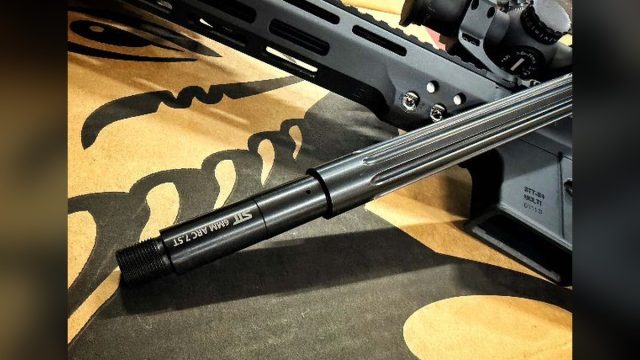
Mine was mounted in a 34 mm Primary Arms cantilever mount on a 24-inch-barreled precision-focused 6mm ARC rifle. You can dig through that 6mm ARC playlist on the channel if you want the host gun story.
Tube, adjustment and the FFP pitch
Front: a 56 mm objective, threaded for accessories, with a Vortex sun shade in the box. The 34 mm main tube is what unlocks the big internal travel. On tape this scope offered about 110 MOA of elevation and 70 MOA of windage (roughly 31 mil elevation / 23 mil windage on the milliradian version). Most scopes in this class then sat closer to 70–80 MOA / ~25 mil of elevation — fine to ~1,000 yards with a modern centerfire, but tight once you push past that or run soft rimfire trajectories.
I walked through a Hornady 4DOF example in the video: with a 100-yard zero you can need on the order of ~27 mil / ~55 MOA to get out toward a mile. Holdovers matter too, which is where the first focal plane reticle helps — hash values stay true at every magnification. Second focal plane is not “wrong”; it is a preference and a use-case choice.
EBR-7C reticle, illumination and parallax
Both the MOA and milliradian Strike Eagle 5-25s used the EBR-7C Christmas-tree reticle: horizontal hashes on the lower half for leads, miss corrections, and holding instead of dialing. I liked the faint center dot with space around it so small targets are not covered the way a fat center blob can be. Vortex ships a dedicated reticle manual, and the glass is illuminated with 11 brightness settings plus off on a CR2032 (battery included). Illumination helps in poor light and on dark targets when the hashes disappear.
On the same side turret stack you get parallax. Spec: focus from about 15 yards to infinity. On my sample the marked parallax distances felt a bit off versus where the target actually snapped sharp — not a deal-breaker, but worth checking on the one you buy.
Turrets: locking, zero stop, and the travel trade
Elevation and windage turrets are nicely sized. Elevation carries two rows of numbers for two rotations: about 25 MOA / 10 mil per turn. With the zero stop installed you get roughly 47 MOA / 18 mil of usable travel — that was one of the most common complaints about the scope. Without the zero stop you regain the full ~110 MOA / 31 mil. Plenty of zero-stop systems only give you one or two rotations anyway; this one is relatively generous, and you can pull the zero stop if you need every click (plenty of how-to videos existed even then).
Both turrets lock: lift to dial, push down to lock so a bump does not walk your zero. Windage has no zero stop, so you get the full windage range. Mag ring is a true 5× erector (5–25×), and Vortex includes a throw lever that helps when fingers are cold.
Other taped specs I was happy to accept: waterproof, nitrogen purged (fogproof), about 3.7″ / 93 mm of eye relief, and a fairly generous field of view — about 24 ft at 100 yards on 5× and about 5.2 ft on 25×.
On the gun: glass and click feel
This was a real review, not a booth walk. Through the scope on steel around the 330-yard mark I demoed the FFP reticle growing with magnification, walked the 11 illumination levels (including at 25×), and ran parallax from infinity down through the marked ranges.
Image quality: attractive in good light. As the sun dropped, contrast fell off versus higher-end Vortex glass — which is exactly how Vortex protects Razor/Viper territory. In poor light I put it somewhere between the Styrka S5 and Styrka S7 I had reviewed around the same era. Brightness also drops at max magnification, which is normal in this class.
Turret feel: parallax and mag rings were smooth. Elevation and windage were audible and tactile but not great — a little mushy with some slop between clicks. Windage was a touch mushier, and I sometimes got two clicks when I wanted one. Still usable; just not the crispest dialers I have run.
Who it was for (and the .22 LR argument)
Friends had been talking about this scope for a while, and I was glad I finally reviewed it. The draw in 2020 was image quality plus that internal elevation, plus being one of the few options at this tier with both a zero stop and locking turrets.
Where I thought it punched especially hard: precision .22 LR. Long-range rimfire was exploding, and with good ammo, steel at 300 yards is realistic. On my older Azimuth 10/22 work the rifle could hit — the optic ran out of travel and I was holding something like ten feet of reticle. A Strike Eagle 5-25 plus a 20–30 MOA base gives a precision .22 a much better chance of dialing instead of guessing.
For centerfire long-range on a budget it was a strong all-around pick. Not the best Vortex scope. Possibly the best Vortex value in that mid lane at the time.
How I would place it next to later glass
Since 2020 we have piled up a lot of mid-tier FFP coverage on the site. If you are shopping the same size class today, cross-check:
- Vortex Venom vs Arken SH4 Gen 2 — the later budget Vortex FFP fight (Venom deliberately cuts elevation compared with this Strike Eagle’s big tube).
- Element Optics Titan 5-25×56 — same mag/objective bracket, different brand and feature set.
- Primary Arms SLx 5-25×56 FFP — another 5-25×56 in the budget/mid conversation.
- Vortex Razor HD LHT 4.5-22×50 — what the higher Vortex ladder looks like when you leave the Strike Eagle neighborhood.
Specs, coatings, and street availability move. Verify the exact SKU (MOA vs MRAD, SE-52503 / SE-52504 and successors) before you buy.
Links
- Strike Eagle 5-25×56 EBR-7C MRAD: KYGUNCO · Primary Arms
- Strike Eagle 5-25×56 EBR-7C MOA: KYGUNCO · Primary Arms
- Related on SlavGuns: Venom vs SH4 · Element Titan · PA SLx 5-25×56 · Styrka S5 · Styrka S7
- Everything else I run: SlavGuns Amazon storefront
- Precision accessories & Anarchy parts (code SlavGuns on Anarchy-made only): slav.li/anarchyoutdoors
- Support the channel: join the Squat Squad on YouTube
Would you run a Strike Eagle 5-25 on a centerfire precision rifle, or is this one better as a high-elevation .22 LR optic for you? Drop it in the comments. Thanks for reading, and keep on squatting!
Some links are affiliates.
Comments