

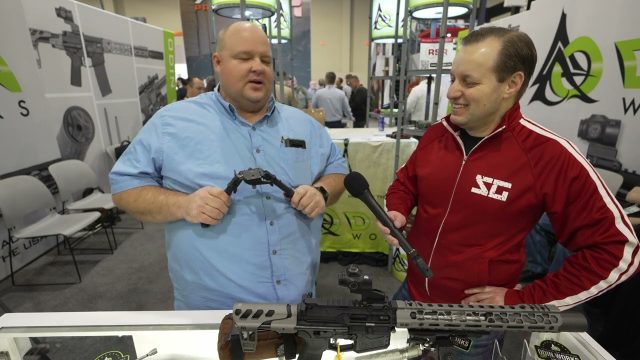
Channel fans and family, this one is a look back to SHOT Show 2023 (the video went up in February 2023). I stopped by the GRS Riflestocks booth, a Norwegian stock company a lot of you had been asking about, and got a full walkthrough of the lineup from Oscar at GRS. This was the first time we’d met in person. I’d already put a GRS Fenris on one of my own rifles, but this was my chance to get hands on the rest of their stocks plus a bipod that ended a long-running argument between me and a friend of the channel.
Quick note: this is a booth walkthrough at SHOT Show 2023, not a SlavGuns range test and evaluation. I handled these stocks at the booth. I didn’t shoot them there.
If you only care about the entry-level stock, I’ve already covered it in depth: the original GRS Fenris write-up and the later GRS Fenris revisited: who should actually buy it. This article covers the whole GRS family and how the models step up from one another.
TL;DR
- Who GRS is: a Norwegian company that has been making rifle stocks since 2010. It started out making furniture parts, and a former army sniper and sniper instructor brought the shooting know-how.
- Fenris: the entry-level stock. It’s fiberglass-reinforced with pillars, drops in, and has push-button length of pull and comb height.
- Bifrost: lighter and more adjustable, with a recoil pad that adjusts for height and cant, Picatinny rails, and a spigot mount for the GRS bipod.
- Warg: the same rear end as the Bifrost with a tactical forend built for a top-mounted bipod, and it’s M-LOK compatible.
- GRS bipod: flip-around feet give you spikes or skids on one bipod. It mounts by spigot or on a top rail with an adapter set.
Who is GRS?
GRS shipped its first stocks in 2010. Oscar told me the backstory, and I love it. He spent 10 years in the army as a sniper and sniper instructor, then came home and took over a company that was making furniture parts. The furniture market was crashing, so they needed something to keep their people employed. They started making laminate stocks and focused on ergonomics and adjustability, since that’s where they could stand out from what was already on the market.
From 2010 to about 2020, GRS built its distribution outside the US. If some of these stocks look familiar, that’s because GRS stocks have shown up on Savage rifles in the past. Around the time of this video they were making a real push into the US consumer market. Their whole philosophy fits in one line: instead of you trying to fit the rifle, you fit the rifle to you. Consistency equals accuracy downrange.
The detail that surprised me most is that hunting is GRS’s biggest market, not competition. Oscar’s argument is that the confidence you build shooting long range on steel carries straight over to hunting. If you know you can put the bullet exactly where you want it, you’re a more responsible hunter, and you also put meat in the freezer.
GRS Fenris: entry level that doesn’t feel entry level
The Fenris is the GRS entry-level stock, though I have a hard time calling it that. Here’s what Oscar walked me through:
- Fiberglass-reinforced with pillars. Drop in your action and torque it up. It’s rigid enough that Savage or Remington owners won’t need to bed it. Oscar recommends a torque driver like Fix It Sticks to set the action screws.
- A grip angled six degrees off the rifle’s centerline. When you point at something your hand sits at an angle, and GRS built that angle into the grip. It feels very natural.
- Push-button length of pull and comb height. It’s quick and one-handed, so you can readjust for a different position, heavier clothing, or a backpack.
- Textured grip and forend.
Many aftermarket stocks sold as “entry level” give you an adjustable comb and then make you use spacers for length of pull, or skip it entirely. The Fenris gives you both without tools. Oscar called going from a standard factory stock to one of these a real before-and-after experience, and I agree.
GRS Bifrost: lighter, more adjustment, bipod ready
The Bifrost is the step up. It’s lighter, has a higher glass-fiber content so it’s stronger, and adds more features:
- Same push-button length of pull and comb as the Fenris.
- A recoil pad that adjusts for height and cant. When you cradle a stock you create a pocket in your shoulder, and the butt has to fit that pocket too.
- Picatinny rails at the front and a section on the bottom, so you can run a bag rider or a rear monopod. GRS also makes bag riders and shooting bags, so you can build a complete system.
- Spigot-ready for the GRS bipod (more on that below). It’s plug and play.
- More inlets than the Fenris. At the booth those included Ruger 10/22, Remington 700, Tikka, Howa, Bergara, and Weatherby. Oscar said Tikka is their number one seller worldwide. That list is as of SHOT 2023, so check GRS for current inlets.
The one I had in hand came in green, and black was available too.
GRS Warg: the long-range version with a top-mounted bipod
If you lean more toward long range, the Warg keeps the same rear end and ergonomic grip as the Bifrost but swaps in a more tactical forend. The reason is GRS’s love of top-mounted bipods.
A bipod mounted under the rifle creates a pivot point during recoil. A bipod mounted on top lets the rifle self-center and sends the recoil straight back. The best explanation I’ve heard: with a typical bipod you’re trying to balance an elephant on a small ball, and with a top-mounted one the rifle hangs like a pendulum, so its own weight helps settle it.
- The forend is M-LOK compatible, so you can bolt on pretty much anything.
- The top rail space works for night vision or a camera. Oscar said cameras are very popular there.
- If you’d rather run a regular under-slung bipod, GRS offers mounts for Harris-style and other bipods.
- The inlet options match the Bifrost.
The GRS bipod: spikes or skids, your choice
This is the part I geeked out on. The GRS bipod is big and beefy and optimized for top-mount shooting, but it also works on the Bifrost: insert the spigot, lock it with one screw, and you’re done.
- Flip-around feet: dig the spikes into the dirt, or flip the feet over so they skid when you’re shooting off a bench.
- Pinned feet, so you won’t lose one at the range.
- Length adjustment plus a locking lever to lock it down once you find your position.
- Top mounting uses the GRS bipod adapter set. It attaches to the top rail with two screws, and the bipod slides on.
Oscar said a big share of these bipods goes to airgun shooters. FX airguns came up, since a lot of those folks shoot off a bench.
Now the argument. Alex from Affordable Optics and I have the same fight every SHOT Show. He won’t look at a bipod without spike feet. Since we do a lot of ELR shooting, I consider a bipod without skid feet a non-starter. This one does both, which is a very clever two-in-one solution. My one nudge to GRS: the adapter in the set is built for Picatinny. A lot of us would love an M-LOK or ARCA option for rifles that aren’t wearing a GRS stock. Oscar promised they’d look into it.
Which GRS is right for you?
- Hunter on a budget, or you just want a factory rifle to finally fit you: Fenris. My full take on who should buy it is in the Fenris revisited article.
- You want a lighter stock, a cant-adjustable butt, rails, and a bipod spigot: Bifrost.
- Prone, long-range, or night shooting where a top-mounted bipod and M-LOK matter: Warg.
- You argue about bipod feet as much as I do: the GRS bipod settles it.
Back then I told you a Fenris was headed for a Howa hunting build, and that’s the rifle you see in my later Fenris video.
Where to find GRS
- GRS Stocks at MidwayUSA
- GRS Rifle Stocks at OpticsPlanet
- Fix It Sticks for torquing action screws
- Precision rifle upgrades: Anarchy Outdoors
- Everything else I run: SlavGuns Amazon storefront
- Support the channel: join the Squat Squad on YouTube
So which would you pick, the Fenris, Bifrost, or Warg? And are you team spike feet or team skid feet? Let me know in the comments. Thanks for reading, and keep on squatting!
Some links are affiliates.
Comments