
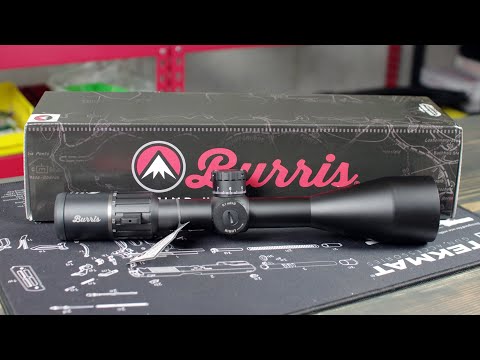
Disclosure: this Burris RT-25 was on loan from the Affordable Optics & Rifle Reviews channel.
Channel fans and family, this one is a look back to June 16, 2021, when the Burris RT-25 5-25x was brand new and I got my first hands on it. Burris has built its reputation here in the United States on two things: a no-questions-asked lifetime warranty (no receipt needed), and BDC reticles, where they were one of the leaders and innovators. One of my own first scopes with a BDC reticle was a Burris. So when they came out with a 5-25x first focal plane scope, I wanted to see what was in the box.
This is an unboxing, features walkthrough and first impressions, not range testing. I looked through it outside on sunny and overcast days, out to about 300 yards. If you want the range follow-up, with shooting out to about 750 yards, read my full Burris RT-25 5-25×56 review.
TL;DR
- What it is: a 5-25x first focal plane rifle scope on a 30 mm tube, with three reticle choices (standard MIL, standard MOA, and the SCR-2 MIL Christmas tree reticle on this one).
- Standouts out of the box: a big built-in throw lever you can move, a reticle that stays usable from 5x to 25x, locking turrets and a hard zero stop.
- Glass: my first words looking through it outside were basically “holy hell, this is actually really nice.” It beat my expectations for its class.
- Trade-off: turrets feel about average, a little mushy, close to a Vortex Strike Eagle. Usable, and less important if you hold with the reticle.
- What’s not in the box: no sunshade and no lens caps.
What’s in the box
You get a nice box with the scope and a packet of paperwork: a user guide specifically for the RT scopes, a standard rifle scope instruction manual, a cleaning cloth and a small Allen wrench. What you don’t get is a sunshade or caps. You’ll have to pick those up separately if you want them, so budget for that when you order.
First thing to do: set the reticle focus
Starting at the back, there’s a nice rubber eyepiece for your reticle focus, and that should be the very first thing you set, because if it isn’t right, nothing else really matters. Go outside and look at a bright sky (or a plain ceiling). You’re not trying to focus on an image, you just want the reticle nice and sharp for your eye. If you wear glasses, set it with your glasses on.
The throw lever is already there
The magnification ring is one of the nicer ones I’ve felt, and the adjustment is really, really smooth. What I liked most is how Burris handled the throw lever. On a lot of scopes, if you’re getting into long range, precision rifle or any gun games, you end up buying a clamp-on lever so you can grab the ring fast. Here you already have a big lever, and from the factory it sat by the 10x mark, which put it in a really good spot: on top at 25x, with 15x and 5x on the other side. Don’t like it there? You can move it wherever you want.
A first focal plane reticle that works at both ends
Quick refresher: first focal plane means the reticle grows and shrinks with magnification, so the holdover marks stay correct at any power. That’s what you want for long-range shooting and range estimation. The usual problem is that on low power the reticle gets so small it’s almost unusable, and if the designer makes it bold for low power, it can cover your target at high power, especially at extended range.
On the RT-25, I think Burris nailed it. The reticle is totally usable at 5x, even better around 8x, and still not super thick at 25x. This one has the SCR-2 MIL Christmas tree reticle, and I really, really loved playing with it. If you want the deeper dive on the SCR-2 hash marks, that’s in the full RT-25 review.
30 mm tube and about 65 MOA of elevation
For this class of scope you might expect a smaller tube, but it’s a 30 mm tube. That mostly affects two things: how much light comes in and how much internal elevation you get. You get about 65 MOA of internal elevation. Call it roughly centered, and you have something like 30 to 40 MOA of usable up, which gets most calibers out to about 1,000 yards, a little more without a canted rail. And because the reticle is a Christmas tree, you’ve got plenty of mils to just hold over instead of dialing.
Turrets: locking caps and a hard zero stop
- Locking turrets: make your adjustment, lock it, and you won’t bump it by accident when you move.
- Hard zero stop: once it’s set, you don’t have to look at the turret. Spin it down to the stop and you’re back on zero. It’s fairly easy to set.
- Feel: fairly audible and fairly tactile, but honestly about average and a little mushy, close to a Vortex Strike Eagle. Totally usable.
- Windage: also locks; no zero stop on that side, which is normal.
My honest read: if you’re buying this scope with the SCR-2 reticle, you probably won’t dial a lot. You’ll hold for elevation and wind, so average turret feel is a fair place for Burris to save.
Parallax with no distance numbers
There’s adjustable parallax on the left side, which you need for precision shooting. If this is your first scope, your old one may not have had parallax at all, since a lot of those are fixed around 100 yards. The difference on the RT-25 is that there are no distance markings, just a faint line all the way up to infinity. Some people will be disappointed, but it also gets rid of the complaint where the yardage on a knob doesn’t match reality. I got it to focus on trees outside as close as about 10 yards with no issues.
Glass first impressions
This is the part that really matters. I looked through it on sunny days and a bit in overcast conditions, and I got very good brightness, resolution and contrast. One of the harder things at the range is an overcast day where the target starts to blend into the background. I didn’t have that issue out to about 300 yards, and I hadn’t looked further than that yet when I filmed.
Like most scopes, from about 20x to 25x you lose a little bit of brightness. It’s not super noticeable, but if you’re looking for it, or you’ve spent time behind much higher-end glass, you’ll catch it. Overall, I’d have zero qualms putting this scope in places where I’d normally put a much more expensive optic, as long as you know those limits.
My take
Out of the box, the RT-25 told me where Burris put the effort: into the image quality and into a reticle built for fast target acquisition and holding wind and elevation. They may have saved a little on turret feel, and you’ll need to buy your own sunshade and caps, but the built-in throw lever, locking turrets and hard zero stop are things you don’t always get in this class. This was a first look from 2021, so check Burris for the current lineup and reticle options, and read the range review to see how it did once it went to work.
More optics reading on the site:
- Burris RT-25 5-25×56: Budget FFP Precision Scope Review
- Primary Arms SLx 5-25×56 FFP Rifle Scope Review
Gear and support
- Everything else I run: SlavGuns Amazon storefront
- Support the channel: join the Squat Squad on YouTube
Do you hold with the reticle or dial your elevation? Tell me in the comments. Thanks for reading, and keep squatting!
Some links are affiliates.
Comments