

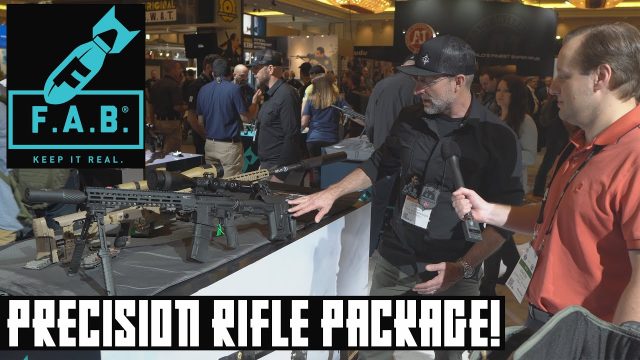
Hey there, Squat Squad, and welcome back to Slav Guns. We’re still on the USIQ tour. After we covered FAB, I was standing there admiring the glass on one of the rifles on the table and had to ask: what’s that thing on the front of it?
It turned out to be a then-brand-new product from a company called ISC, short for Internal Scope Cap. Don Wright from USIQ walked me through it, and it’s one of those ideas that makes you go “huh, why didn’t anyone do that sooner?”
Quick note on what this is: it’s a booth interview and first look. I didn’t run one of these on my own rifle, so there’s no range test here. Price and availability are what Don quoted at the time of filming.
TL;DR
- What it is: a scope cap with a built-in iris, like a camera lens, so you can open and close it to control how much light goes into your scope.
- Who made it: developed by an Army sniper who saw a real need for light reduction and protection on expensive glass.
- The cool part: closing the iris does not shrink your field of view. You just see the image get dimmer.
- Protection: fully waterproof, with a glass lens in front that keeps weather off your objective. The honeycomb insert is removable.
- Fit: slip-on and direct-thread versions, made in sizes for the popular scopes.
- Price: starting at about $150 at the time, available through OpticsPlanet.
An iris for your riflescope
The tech in this thing is an actual iris. It works very much like the aperture on a camera lens: you open and close it to control how much light is going in. Don gave a few reasons you’d want that:
- Glare: if you’re shooting downrange with the sun in your face, you can dial down how much light is hitting your scope. Precision shooters like it for exactly that.
- Tactical: you can squeeze it down to just enough to see your target, so there’s less chance of someone spotting your lens.
- Protection: you bought a very expensive piece of glass, and this is meant to be the best way to protect it.
Does it change your field of view?
This was my first question, because when you watch it open and close it looks exactly like a camera lens, and you’d expect your view to shrink along with it. Don said no, and that this is the coolest part. If you’ve never done it before, it kind of shocks you. As you crank it down, the field of view doesn’t change at all. All you see is the image dimming, right down until it’s a pinprick. If you’re on a target way out there and you have it closed down to about a quarter inch, the target looks exactly the same size.
Weather protection
The ISC is fully waterproof. There’s a glass lens in it that keeps the weather out, so if you’re hunting with the rifle on your shoulder and it’s raining, your objective stays clean. The honeycomb is removable too, so if you don’t need that extra level of light control, you can pull it out.
Don made a point any camera guy will get right away: you put a filter on your lens so that if you break glass, you break the cheap glass, not the good stuff. Same idea here.
This also lines up with something I’ve said for a while about sunshades. I think a sunshade is most useful not for blocking the sun, but for keeping snow and rain off your front lens. The ISC goes after the same problem with an actual sealed lens in front.
Not for budget scopes
Here’s my one caveat, and Don completely agreed with it. If the whole point is to cut light, you probably don’t want to put this on a lower-end scope that already has poor light transmission or a small objective. Anytime you put a piece of glass or anything else in front of your objective, you lose a little bit. These are flat-out made for higher-end scopes that are already pulling in a lot of light.
If you’re shopping for that kind of glass, my Sightmark Latitude 8-32×60 review and my Styrka booth tour are good places to start.
Sizes, price and availability
ISC makes both slip-on and direct-thread versions. The one on the back of the table was direct thread, and Don said they make sizes for any of the popular scopes. At the time of filming, they started at about $150 and were fully available through OpticsPlanet, with worldwide availability coming. That was 2020 pricing, so check what they cost now before you buy.
Bottom line
For $150 or so, the ISC does three jobs: it cuts glare, it hides your lens, and it keeps weather and impacts off an expensive objective, all without changing your field of view. I’d want to try one on my own rifle before I call it a must-have, but if you’re running high-end glass in the sun, the rain, or the field, this is a really interesting option. Just don’t put it on a budget scope that’s already struggling for light.
This is part of the USIQ tour. If you missed the earlier stops, check out the FAB precision rifle kit first look and the Helix6 carbon fiber barrel first look. The rests, bags and range gear I use are in my Amazon picks.
Want more optics and precision rifle content? Join the channel.
Keep squatting.
Would you put an iris cap on your scope, or are you sticking with flip caps and a sunshade? Tell me in the comments.
Some links are affiliates.
Comments