
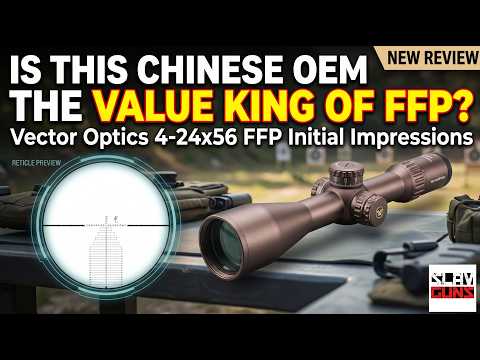
Hey there, Squat Squad, and welcome back to Slav Guns. A while back I wrote up my first impressions of the Vector Optics Continental 4-24×56 as a PRS Rimfire and NRL22 Base class optic. This piece comes at it from a different angle: the question I get asked all the time. If you can buy a scope like this straight from the Chinese OEM, why would anybody pay four times as much for a Western brand? And where does the cheaper scope stop being enough?
Disclosure: the scope was provided by Vector Optics for testing and evaluation. Vector Optics did not see the video before it was published, and no compensation was received. These are initial impressions from time with the scope at home and a first range session, not a long-term or match review.
TL;DR
- Rimfire inside 300 to 400 yards: I think the Continental 4-24×56 is more than most shooters will ever need.
- Centerfire inside 500 to 600 yards: same story. It does everything you need it to do.
- Past that, or in serious competition and bad conditions: that’s where the higher-end glass earns its money.
- The honest caveat: premium scopes aren’t five times better, but when you need that last 5 to 10 percent, it’s worth paying for.
The OEM-direct wave
Over the last few years, American shooters have figured out how much value there is in buying from Chinese OEMs, or from brands closely tied to them. DNT, Arken, and Discovery all proved the point. Vector Optics is another one. They’ve been building product for quite a few other companies for years, and now they’re selling to shooters directly. The Continental line is their top-tier house brand. It includes the 2-12 I already reviewed, this 4-24, a 3-18, a 5-30, and a 6-36. Vector sent the 6-36 too, and that one gets its own video and comparison later.
If you like the Telson Target Master or a lot of the Hawke optics, the Continental will feel very familiar.
Why it went on this rifle
Before this, the rifle wore the Primary Arms SLX 5-25×56. It checked a lot of boxes for PRS Rimfire Production and NRL22 Base, but two things bugged me in matches. The reticle was busy, with stadia lines that were a little big for me, and the field of view felt tight. My ideal picks, the TRACT 4-25×56 and the Telson Target Master 5-25, would have pushed me over the class price cap. So the Continental was the one that fit.
I went with the 4-24 over the 5-30 because it gives a little more internal elevation and a slightly wider field of view. For rimfire you’re typically topping out around 18x anyway, at roughly 300 yards.
What you get for the money
Features that check the boxes
- About 34 mils of internal elevation.
- Zero stop and locking turret caps.
- Revolution indicators: a red indicator pops up on your second turn and a silver one on the third. If you have a brain fart and forget to dial back to zero, you know exactly where you are.
- Illumination with off positions between each setting.
Even with a 30 MOA base, I still have room to dial about 13.5 mils, which is enough to reach 300 meters with a .22. On a centerfire rifle, 13.5 mils will get you out to roughly 1,300 to 1,400 yards, or even a mile, depending on the cartridge.
The reticle
The reticle was a big reason I switched. I want the top half as clean as possible so I can spot my own shots and transition between targets. This one has no upper vertical stadia beyond about four mils of hold. It’s a Christmas tree style below, so holdovers are fine. There’s a rangefinding feature I’m not crazy about, but it sits out of the way instead of crowding the vertical stadia. Vector also offers a version with a cleaner reticle without the rangefinding feature. Mine came with their traditional one.
The glass
Vector says on its website that this is ED glass and uses a mix of glass suppliers, including Schott. Is it the same as a high-end TRACT or a Nightforce? No. But it’s a clear step up from the Primary Arms and, I’d assume, some of the lower-end Arkens. The color looks more natural, with fewer tints, and chromatic aberration is better controlled. Side by side on target at 300, it’s sharper. Where that really shows is on a plate rack or thin targets at 200 yards, where it cuts through mirage noticeably better.
The trade-off
The field of view is wide, which saves time between targets because you don’t have to zoom in and out as much. The cost is a slightly narrower eye box and some distortion around the edges. Stay centered and the image is completely fine. Just know it’s there.
Where budget stops being enough
Going directly to an OEM gets you a better scope for the money. That’s the whole appeal. But there’s still something to be said for a $500 scope versus a $2,000 scope: even with markups, more money spent on components gets you a better scope.
Here’s where I draw the line:
- Rimfire, inside 300 to 400 yards: fantastic. It does everything you need it to.
- Centerfire, inside 500 to 600 yards: more than enough.
- Beyond that, or if you compete seriously or shoot in harsh conditions: that’s when you’ll probably want something higher end.
The same goes for the Arkens, the DNTs, and the rest. They’re good value, but there’s a reason Nightforce, Leupold, Tangent Theta, Kahles, and Zeiss cost more. They’re better products. Are they five times better? No. But if you ever need that extra 5 or 10 percent, you’ll gladly pay for it. That’s why it’s a little misleading when somebody says, “Sure, you can take this scope and go shoot a mile.” Yeah, you can. It’ll just be a better, more fun experience with a higher-quality optic.
What’s next
The plan from the video is to run the Continental in a PRS Rimfire match for a full review with match footage. After that it goes on a centerfire rifle out to around 700 yards for a final verdict. If you want to see how Vector updated the line later, check out my look at the Continental Gen 2 with swappable turret caps.
Bottom line
The Continental 4-24×56 is a great example of what the OEM-direct wave gets you: real features, a clean reticle, and glass that beats what you’d expect at the price. For most rimfire and mid-range centerfire shooting, it’s plenty. If you’re chasing a mile or a podium in nasty conditions, know where the budget glass runs out.
The gear I use and recommend is on my Amazon storefront, and if you want to support the channel and get the members-only cuts, join the channel.
Keep squatting.
Where do you draw the line on budget glass: rimfire only, 600 yards, or all the way out? Tell me in the comments.
Some links are affiliates.
Comments