
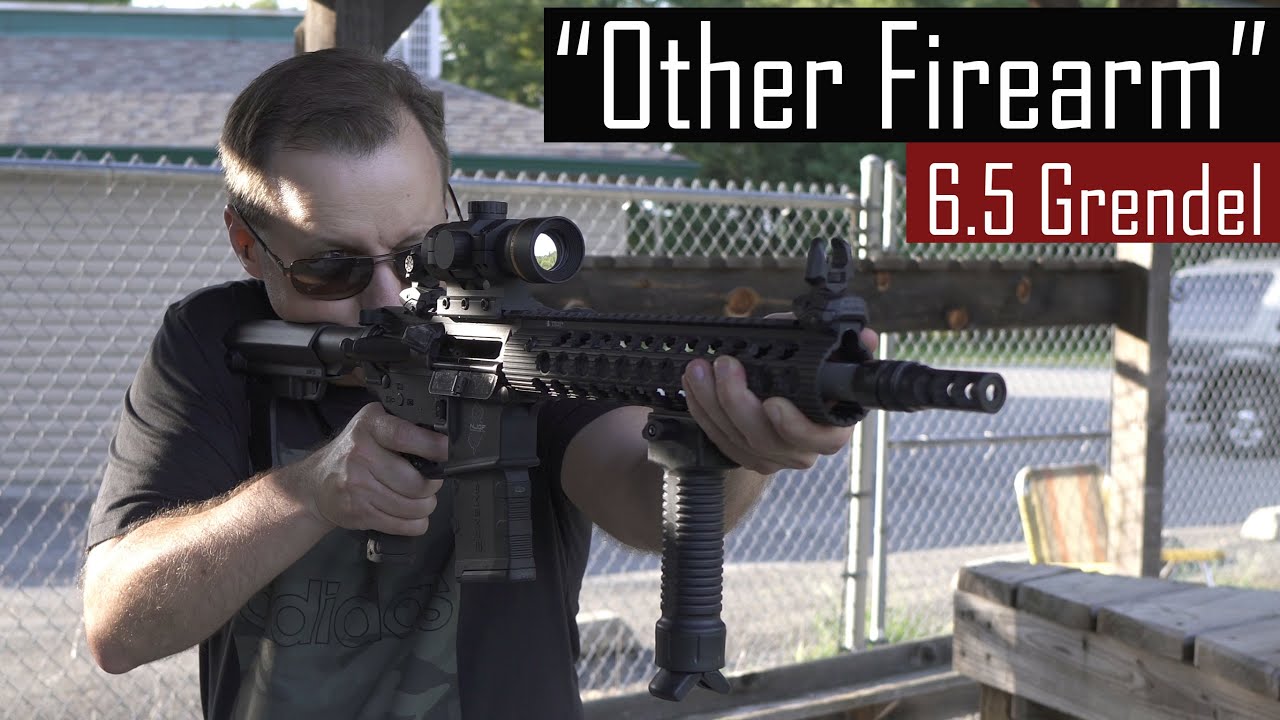
Hey there, Squat Squad, and welcome to Slav Guns. If you live in a banned state like New Jersey or Connecticut, you’ve seen the trend: the “Other Firearm,” a legal way to have features that are otherwise banned in those states. When I made this video, other firearms were among the best-selling guns in NJ and CT, the store shelves were empty, and you were asking me every single day whether you could build one yourself. So I did. This is my Slav-approved 6.5 Grendel Other Firearm, built around a 12.5″ Rainier Arms match barrel.
Disclosure: Parts were provided by Rainier Arms, Mission First Tactical, Ruger, FAB Defense, and Wojtek Weaponry for testing and evaluation. The companies did not see the video before it was published.
Heads-up: I filmed this in October 2020. Gun laws and regulations (including how pistol braces are treated) have changed since then, so treat the legal discussion below as what I understood at the time, not legal advice. Verify current federal and state law before you buy or build anything.
What is an “Other Firearm”?
One of the most popular series on the channel has been on this category: the Troy A4 in both 9mm and .223 in a number of barrel lengths, plus the feature-packed Dark Storm Industries Variant 1. Here’s the definition one more time (for like the fifth time):
- It’s not a rifle, because it isn’t designed to be fired from the shoulder with a stock.
- It’s not a pistol, because it’s designed to be fired with two hands, including a vertical foregrip.
- It’s not an AOW (Any Other Weapon), because the overall length from the back of the buffer tube to the tip of the barrel is over 26 inches.
That’s why other firearms typically have a vertical foregrip and are built around a 12″ or 12.5″ barrel. And don’t confuse an AOW with an Other Firearm. That one inch is the difference between something that has to be registered with the ATF and state police, and a gun that was simply transferred based on its lower receiver.
Can you build one yourself?
At the time, yes, as long as it’s put together from a virgin lower receiver that was never sold as a rifle. That means you can’t take your Ruger AR-556 or Smith & Wesson M&P15 and convert it. It has to start as a brand-new lower that was sold as a lower.
What about New York? I got that question almost every other day. You can probably find an FFL selling them, but nearly everyone I talked to at the manufacturer level believed it’s not legal in New York. Other firearms worked in NJ and CT because the evil-features laws were written for long guns and pistols, and other firearms are, well, other firearms. New York’s SAFE Act is written so it applies to receivers too, which makes the whole configuration moot since it uses an AR-15 lower. In New York you’re looking at featureless builds or the newer fixed-magazine options, like the ones from Dark Storm Industries, a New York-based manufacturer.
And if you live in free America? For you, an other firearm is essentially a way to legally have a vertical foregrip on an AR pistol, just a little longer overall.
The goal: 1,000 yards from an Other Firearm
I’d already reviewed a bunch of Troy and DSI options in .223 and 9mm, and most other firearms out there are in those calibers. I wanted something quite a bit different: could an other firearm hit steel at 1,000 yards? I reached out to a number of companies with my slightly nutty goal, combined their parts with a virgin lower I’d been saving and a few small parts I had, and this is Slav-approved build number two.
The upper
- Barrel: Rainier Arms 12.5″ 6.5 Grendel Match. If you’re not familiar, 6.5 Grendel is in a sense a necked-down 7.62×39. It still fits the AR-15 platform but delivers more energy and extends usable range by a few hundred yards over .223. I’ve used Rainier barrels before and liked the value. The Match series gives you much of the quality of their Ultra Match at a more attractive price; this one was around $225 to $250 when I filmed. Rainier guarantees these barrels will shoot sub-MOA with match-grade ammo, and I fully plan to test that. It has a 1:8 twist, standard for 6.5 Grendel, and is threaded 5/8×24.
- Why 12.5″ and not 12″? You generally need 12 to 12.5 inches to clear the 26″ overall length. You can get shorter by permanently attaching a muzzle device, but I no longer live in New Jersey, so I stayed with 12.5″ for the flexibility to swap muzzle devices. The extra length also helps velocity, which I’ll need at 1,000 yards.
- Muzzle: Patriot Valley Arms Jet Blast compensator. Insanely effective, and self-timing: no shims, just thread it on, align it, and hand-tighten the lock ring. It’s also threaded for a Rugged suppressor, so you get a good brake and can throw on a good can whenever you feel like it.
- Gas: Wojtek Weaponry adjustable gas block. Since I planned to run it with and without a suppressor and wanted to tune recoil, I went adjustable. Mine is the clamp-on version; they also make a traditional set-screw mount. Very reasonably priced and it has been quite effective.
- Upper receiver and rail: I repurposed an older, unused upper (I believe from Spike’s) and a Troy Alpha rail, one of my favorite rails for a long time.
- BCG: An existing nickel boron bolt carrier group from AIM Surplus, with the bolt swapped for a 6.5 Grendel bolt.
- Charging handle: Cedar Mill Firearms ambidextrous extended. At around $40 it’s a very nice upgrade, and if you’re running a scope you absolutely need something like it to manipulate the gun.
- Vertical foregrip: Grip-Pod. This is the part that keeps it an other firearm. I’d had it for a while without a use; for this build and the 1,000-yard goal, it’s perfect.
- Deflector Brake from Havoc Tactical Solutions. I put these on all my ARs. 6.5 Grendel brass is expensive, and the Deflector Brake reduces dings on the necks and how much the brass gets worked during resizing.
- Completing the upper is a run-of-the-mill carbine gas tube.
The lower
- Virgin Spike’s AR-15 lower, engraved with the NJGunForums logo, which felt very appropriate for this build.
- Palmetto State Armory lower parts kit.
- Ruger Elite 452 trigger. An excellent 4.5 lb two-stage trigger with very short take-up and a clean break, far better than standard mil-spec, and attractively priced at around $150 or less when I filmed. It comes in a housing you can also use with your existing trigger as a dry-fire aid.
- FAB Gradus grip. My new favorite AR pistol grip. It’s upright and works for both run-and-gun and precision shooting. It’s part of FAB’s precision package of upgrades along with their adjustable stock and the Spike bipod.
- Mission First Tactical oversized trigger guard. Easy to install and makes the gun easier to use with gloves.
- Mission First Tactical pistol brace. The other required part of an other firearm. I usually run SB Tactical braces like the SBA3, but I wanted to try the MFT brace because it’s an awesome value from a great company. Note that it doesn’t adjust; you lock it at your desired arm length.
Optics and magazines
For now it wears the Leupold Freedom RDS, co-witnessed with FAB backup sights. It was my first time using those sights, and they seem very sturdy and are easy to adjust. For longer distances I’ll swap in either a low-power variable like the Styrka S7 or a higher-magnification optic for accuracy testing, such as the Vortex Strike Eagle or the 5-25 my friend Alex at Affordable Optics let me borrow.
For magazines I’m running a combination of the Amend2 polymer 10-rounders and the Duramag 20-rounders. If you need 6.5 Grendel / 6mm ARC mags, here are the Duramag 20-round stainless magazines at GunMag Warehouse.
At the range
The reason that Jet Blast is on there: once you bring another firearm back to free America, you can put a Rugged Surge on it (suppressors are NFA items, so that means a tax stamp and a dealer transfer where they’re legal). Holy blowback with the can on, but much quieter. The red dot also kept flickering on and off on me; turns out the battery was dead.
Can you squat it?
Without the brake it might be a little more difficult, because you definitely feel the recoil, especially with that thin piece of plastic brace against you. With the brake? It rocks back a little, but it’s totally squattable.
Bottom line: the risks
Putting together an other firearm is a relatively simple proposition for those in New Jersey and Connecticut. But there are risks:
- Redefinition. There’s always a chance NJ and CT go after other firearms, and there likely wouldn’t be any grandfathering. The good news at the time: changes seemed like they’d need to happen legislatively, and there were already over ten thousand factory other firearms in those states, not counting home builds.
- No state police letter. As far as I knew, only the Troy A4 and the Dark Storm Industries other firearms had a letter stating they were examined by the New Jersey State Police and found compliant. For many people that’s worth paying more for to sleep well at night.
- You’re responsible. If you get hassled at the range or pulled over, how comfortable are you explaining why this is an other firearm and not a pistol with an illegal vertical grip, or an SBR? When you build your own, it’s on you to stay within the confines of an other firearm and not accidentally build a pistol, a rifle, or an AOW.
I’m quite happy with how this turned out, and it was the only way I could get a 6.5 Grendel with the components I wanted. Next up, I’ll swap the red dot for a scope and shoot some groups. I’m very interested to see how far out that 12.5″ Rainier barrel can hold sub-MOA.
Gear I use: slav.li/amazon. Squat Squad perks: join the channel.
Keep squatting.
Would you build your own other firearm, or pay up for one with a state police letter?
Some links are affiliates.
Comment here